Progress in Carbon Neutrality
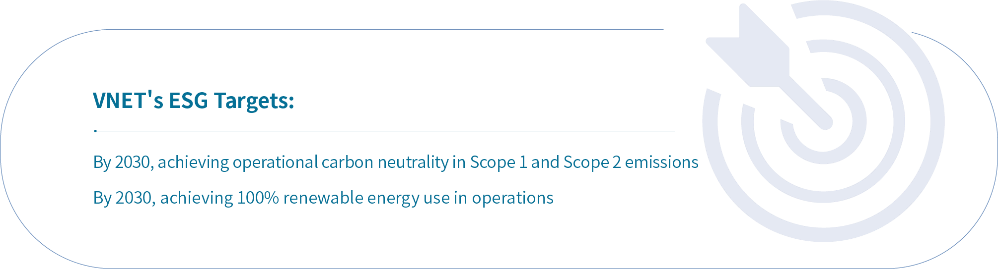
Our targets
VNET is facing the global challenge of climate change by setting ambitious carbon reduction targets to advance the Group's low-carbon transition.
Our strategies
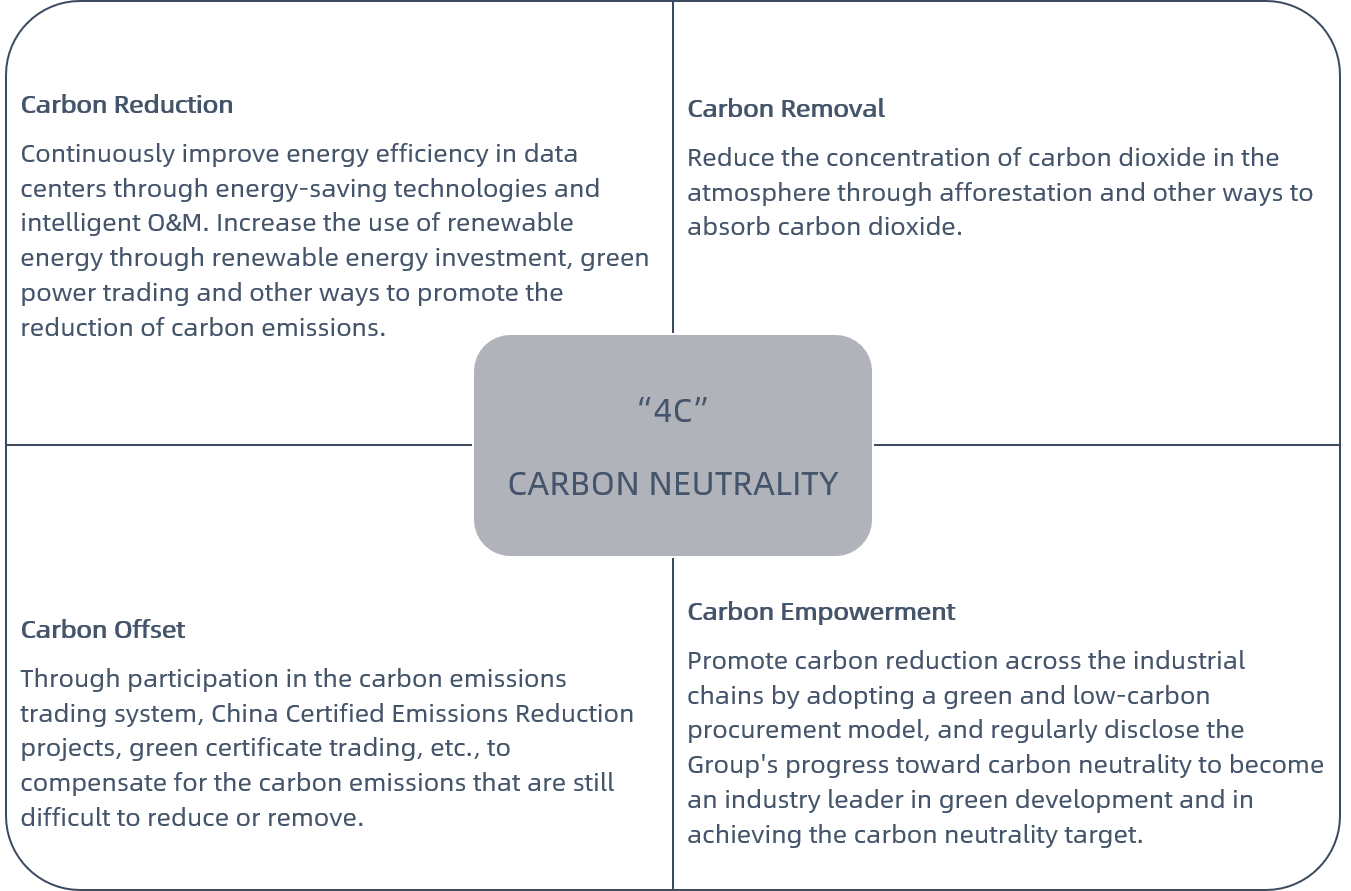
We have developed a “4C” pathway toward carbon neutrality, comprising carbon reduction, carbon removal, carbon offset, and carbon empowerment. This pathway drives the achievement of the Group’s carbon neutrality goals by applying energy-efficient technologies, accelerating the transition to renewable energy, participating in carbon market trading, and empowering collaborative efforts across the industrial chain.
GHG emissions verification
VNET set ambitious carbon reduction targets to advance the Group’s low-carbon transition.
The Group conducts an annual inventory of greenhouse gas emissions within the organizational and reporting boundaries, covering Scope 1, Scope 2, and Scope 3 emissions. This inventory is verified by a qualified independent third-party in accordance with the ISO 14064-3:2019 Specification with Guidance for the Verification and Validation of Greenhouse Gas Statements.
We enhance energy efficiency, increase the proportion of renewable energy use, and adopt carbon offset measures to continuously strengthen our decarbonization efforts.
Stimulating Green Productivity
VNET is actively exploring innovative energy pathways and proactively responding to the national call to build a new energy system. Guided by the mission of “bring green direct-current electricity from data centers to millions of households”, VNET is commited to developing “Hyperscale 2.0” green direct-current hyperscale data center clusters that meet the needs of energy structure transformation, technological advancement, and market-oriented operations. By transforming new digital infrastructure into a key resource of the new energy system, VNET drives the green and low-carbon transformation of computing infrastructure, supports the high-quality and sustainable development of the digital economy, and contributes to the development of a green, intelligent, and efficient industrial system for the new era.
Renewable Energy
·Build a New Ecosystem of "Green Power + Computing Power"
With the rapid development of technologies such as artificial intelligence, the demand for data center computing power is experiencing exponential growth. In this context, promoting green and low-carbon power supply in the power supply segment and achieving the efficient conversion of green electricity to green computing power have become key to addressing the balanced development between computing power and electricity.
VNET upholds the synergistic development concept of “computing power + electricity” and adheres to innovation-driven practices. We are deploying new computing infrastructure around the “Eastern Data, Western Computing” hub nodes, with green direct-current electricity, power-computing synergy, and virtual power plants as core technical directions, to build a full-chain closed-loop system covering green electricity production, transmission, dispatching, and consumption. We actively promote the consumption of wind and solar green power resources and improve the utilization efficiency of green energy. This approach not only drives the green upgrade of computing power, but also promotes the deep integration and systematic innovation of computing power and electricity, thereby transforming data centers from traditional energy consumers into participants and supporters of the new power system.
In April 2025, the "Power-Computing Synergy Near-Zero Carbon Data Center Demonstration Project" submitted by VNET based on the Ulanqab Integrated Source-Grid-Load-Storage Project was successfully included in the National Development and Reform Commission’s (NDRC) list of green and low-carbon demonstration projects. This achievement represents an important milestone for VNET in the field of new power systems for computing power infrastructure, marking a critical step in promoting energy structure transformation and advancing the national dual carbon goals.
The VNET Huailai Data Center explores and implements an innovative power-computing synergy model for intelligent computing centers under the “dual carbon” goals. The project adopts advanced energy-saving technologies and equipment and plans to deploy a large-scale energy storage system. It also fully taps the regulation potential of backup power sources such as uninterruptible power supply (UPS) systems and diesel generators, elevating load flexibility to a new level. By leveraging virtual power plant technology, the project actively participates in grid peak shaving, frequency regulation, and demand-side response. Through this new “power-computing synergy” model, it effectively achieves peak shaving and valley filling, smooths the load curve, and contributes to building a new power system.
·Self-built “Distributed Photovoltaic
VNET fully leverages the existing space and resources of its data centers to deploy distributed clean energy, enhancing the self-sufficiency of renewable energy. This approach increases the use of green electricity and optimizes the power distribution system, while achieving both economic and environmental benefits.
We have built and operated self-built photovoltaic systems on the rooftops and carports of three projects: the Foshan Smart City Data Center, the Beijing Yizhuang Boxing Data Center, and the Taicang IDC Campus. In 2025, the total power generation of these systems reached 377,845 kWh, which represented a reduction of carbon dioxide emissions by approximately 206 tonnes and saved about RMB230,000 in electricity costs in total.
·Renewable Energy Procurement
With the goal of achieving 100% renewable energy by 2030, VNET accelerates its energy transition by procuring renewable energy to substitute traditional energy sources. In 2025, the Group’s total energy from renewable sources was 1,253,719 MWh, reducing greenhouse gas emissions by approximately 726,167 tonnes. The percentage of renewable energy reached approximately 36%.
The Group effectively allocates green electricity resources and ensures a stable supply through long-term framework agreements for green electricity procurement and participation in cross-provincial green electricity trading. In 2025, the Group made significant progress in renewable energy adoption, with the share of green electricity consumption among data centers participating in market-based trading steadily increasing. Among them, over 80% of the electricity consumed at the Ulanqab IDC Campus is drawn from renewable sources, while adoption of green electricity at the Taicang and Huailai IDC Campuses continues to show a steady year-on-year growth.
Market-Oriented Power Operations
The Group actively advances the strategic layout of market-oriented power trading, continuously deepens research and practice in the power market, and constantly optimizes market-oriented operational capabilities, including electricity price analysis and forecasting, load matching, and clean energy consumption, to proactively respond to policy guidance on green electricity trading and power market reform. Meanwhile, the Group accelerates the development of an intelligent decision-support system for the power market, establishing intelligent trading and risk control mechanisms grounded in data and algorithms. This drives the evolution of decision-making toward data-driven and intelligent models, comprehensively elevating market-oriented trading capabilities and green energy utilization assurance, thereby facilitating the green and low-carbon transformation of the energy structure and optimizing computing power costs.
Carbon Market Trading
VNET actively participates in carbon market trading in Beijing, Shanghai, and Guangdong, and reduces carbon allowance consumption by offsetting emissions through the use of green electricity. This enables the Group to more accurately quantify the effectiveness of its carbon management and identify opportunities to improve energy and carbon efficiency. In 2025, the Group traded approximately 40,000 tonnes of carbon allowances, effectively controlling carbon emission costs while further strengthening the foundation for its low-carbon development.
Full-Lifecycle Management of Green Data Centers
VNET actively aligns with the national policies on the green environmental protection of the digital industry and integrates green development principles throughout the full lifecycle of data centers, including site selection, design, construction, and operation. Focusing on “building standardization, modular data cemters, and bus-based electrical systems”, VNET ensures the quality of computing power services while driving the transformation of data centers toward energy-efficient, low-carbon, flexible, and efficient operations.
By the end of the reporting period, VNET has obtained 11 green data center certifications, and multiple operational sites have obtained Environmental Management System (ISO 14001) certifications.
Site Selection and Planning
During the site selection and planning phase, VNET considers sustainability and fully takes into account factors such as local environmental conditions, resource supply, and ecological environment. For example, we regard the accessibility and supply capacity of renewable energy as one of the important evaluation factors in data center site selection. We position our business operations in regions such as Ulanqab and Huailai, which are rich in green energy and offer natural cooling advantages, aiming to enhance the integration capability of green energy and optimize the energy structure.
We strictly comply with relevant laws and regulations, including the Law of the People’s Republic of China on Environmental Impact Assessment and Regulations on the Administration of Construction Project Environmental Protection. Prior to project development, we conduct an Environmental Impact Assessment (EIA) to systematically evaluate the project’s impacts on pollutant discharge, resource consumption, ecological environment, and other aspects in the proposed project area. Meanwhile, guided by the Convention on Biological Diversity of the United Nations and other biodiversity-related principles, we assess potential impacts on nature reserves, water source protection areas, wildlife and flora, and other relevant aspects in the project’s environmental impact report, formulate corresponding mitigation and protection measures, and take actions to minimize the adverse impact of project operations on biodiversity to the greatest extent possible. Currently, all of the Group’s operating locations are neither situated in nor adjacent to nature reserves or other areas with rich biodiversity.
R&D and Design
The Group strictly adheres to the Code for Design of Data Centers (GB 50174-2017) and benchmarks against internationally recognized standards for data center reliability and resillience, such as the Uptime Institute Tier III Ready standard. While ensuring computing capacity requirements are met, we fully integrate green design principles.
In data center campus planning, we achieve energy conservation and consumption reduction through scientific layouts and the effective use of natural ventilation, solar exposure, and other passive design strategies. In architectural design, we leverage the thermal performance of building envelope systems, including roofs and exterior walls, to enhance insulation and energy efficiency. Additionally, based on equipment operating characteristics, we optimize spatial layouts and system configurations, prioritize high-efficiency equipment, and support the achievement of industry both economic and environmental benefits.
In addition, water-use effciency is a key metric for assessing the sustainability of data centers. We prioritize maximizing intensive utilization of water resources during the project planning and design phase by comprehensively assessing water resource conditions at project sites and analyzing and forecasting current and future water supply capacity, thereby enabling solutions tailored to local conditions. In regions that may face water scarcity, the Group prioritizes water-free or water-efficent HVAC (Heating, Ventilation, and Air Conditioning) systems to reduce water consumption and mitigate risks associated with extreme water shortages, while ensuring cooling requirements are met. We also incorporate water recycling and resuse mechanisms into the design, including water reuse systems in drainage processes to support outdoor landscaping and road cleaning, thereby further improving overall water-use efficiency.
Project Construction
From the outset of data center construction, we have integrated environmental protection principles throughout the project. We have established a comprehensive environmental management system for construction sites, implementing targeted measures in areas such as dust control, noise reduction, waste emissions, resource management, and the selection of building materials, to minimize the negative impact of construction activities on the surrounding environment and local communities.
We implement technologies such as building standardization and modular data centers to improve equipment utilization and construction efficiency. These measures help reduce dust, noise, waste pollution, and resource consumption at construction sites, while effectively minimizing construction-related risks to personnel. We have applied prefabrication technologies in data centers across multiple locations nationwide, achieving simplified delivery processes, shortened delivery cycles, precise quality control, and low-carbon environmental protection.
Project Operations
VNET is committed to building compact efficient and intensive data centers, enhancing environmental performance through innovation, and empowering the sustainable development of data centers. In 2025, the average annual PUE of our data centers under stablized operations was 1.24.
- Energy management
VNET continuously explores and innovates in the field of energy management. By refining energy-saving management systems, promoting the application of green energy-saving technologies, and building intelligent platforms, we consistently improve the O&M efficiency of our data centers. The Group has formulated and implemented the Energy Management System, Energy Metering Management System and other policies to regulate and guide energy conservation, consumption reduction, and cooling efficiency improvement in data centers. Meanwhile, the Group regularly conducts energy audits, analyzing and verifying key energy efficiency indicators such as PUE for data centers, identifying areas with low energy efficiency and high energy consumption, and formulating corrective action plans to enhance energy performance. Through measures such as adjusting equipment operating parameters and frequencies, optimizing equipment configuration, and replacing outdated equipment, the Group drives continuous improvement in data center energy efficiency. Multiple sites involved in the Group’s core business operations have achieved certification under the Energy Management System (ISO 50001).
- Water Resources Management
VNET actively responds to national policies aimed at improving water resource utilization efficiency in data centers by promoting the use of reclaimed water and reducing the intake of fresh water. The Group places a high value on the intensive utilization and sustainable management of water resources. Through measures such as developing and applying water-free cooling technologies, utilizing reclaimed water recycling technologies, and exploring rainwater collection and reuse, VNET continuously improves the operational efficiency of existing water-cooling systems, effectively reduces reliance on natural water sources, and achieves efficient water resource utilization.
At our self-built data center campuses in Beijing, Langfang, Huailai, and Ulanqab, we promote the comprehensive use of municipal reclaimed water. During the planning and design phase, reclaimed water treatment facilities and pipeline systems are installed to ensure that, after the projects are put into production, production water in the campuses can be recycled through the reclaimed water system, contributing to greener and more sustainable development.
- Waste Management
The waste generated by VNET mainly consists of electronic waste and general waste from data centers and offices. We strictly comply with applicable national laws and regulations to implement standardized management throughout the entire process, from waste storage and transportation to disposal. In our daily operations, we implement waste classification and maintain waste management ledgers to proactively identify and manage waste produced during our operations. Furthermore, we improve resource utilization efficiency through waste recycling, strictly control pollution, and ensure the effective implementation of environmental protection measures.